FRnOG #34: how we deployed a datacenter in one click
Vincent Bernat
Here are the slides I presented for FRnOG #34 in October 2021. They are about automating the deployment of Blade’s datacenters using Jerikan and Ansible. For more information, have a look at “Jerikan+Ansible: a configuration management system for network.”
The presentation, in French, was recorded. I have added English subtitles.1
Transcript#
Hello! I’ll tell you how we at Blade deployed a datacenter in one “click.” The title is a little bit clickbaity because we didn’t click anywhere. This is the joint work of the former Blade network team. My colleagues are in the room.
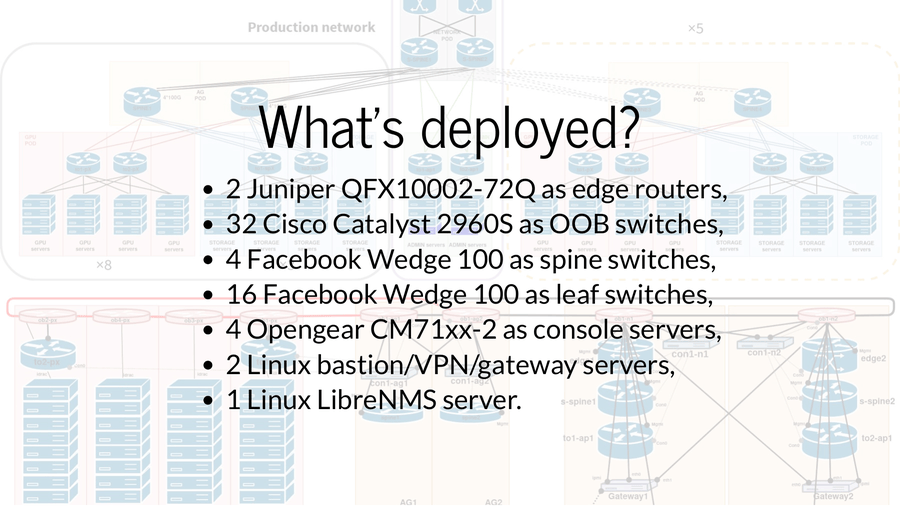
The scope is just the network part of the datacenter. Edge routers, OOB switches, spines, leafs, console servers, two Linux servers that are central to the whole network management, and a LibreNMS server for the supervision.
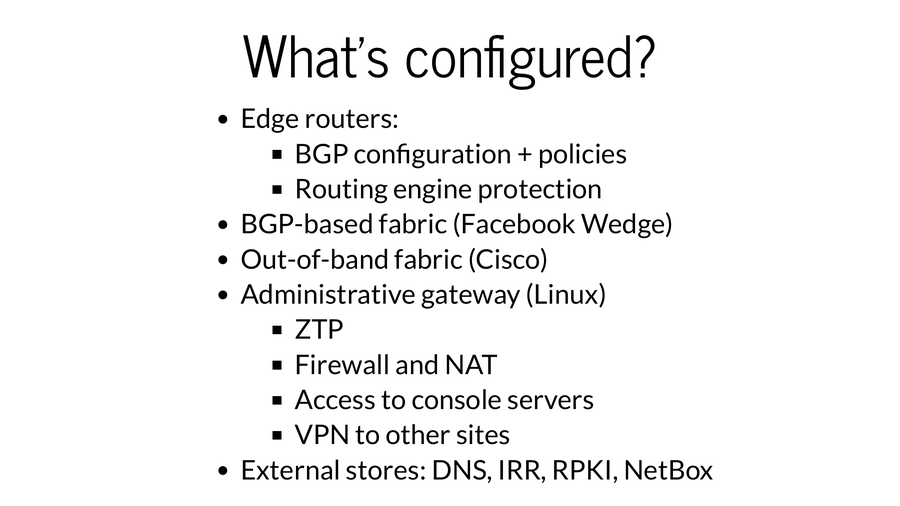
At the end of the deployment, all that is configured: the edge routers, including BGP sessions, policies with transit providers and peerings, a BGP-based fabric, the out-of-band management fabric, the management servers which are also the gateway to the management network, with ZTP, firewall, NAT, access to console servers, the VPN to other sites, and all external systems: DNS, IRR, RPKI, NetBox. All this is configured automatically at the end of the deployment.
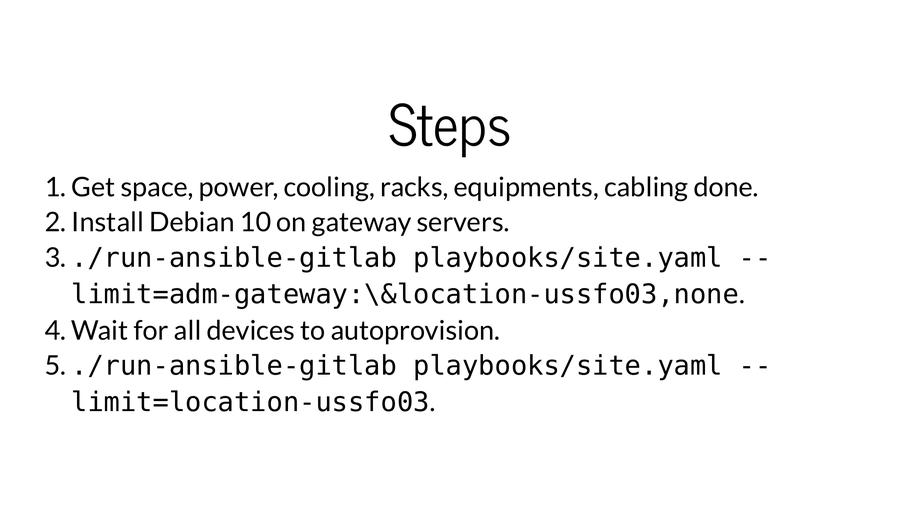
There is a first step where you have to buy space, power, cooling, racks, equipment, and plug it all in. Then, on the gateway servers, you install a Debian 10. From your laptop, you run a short command which will do the first step of the provisioning.
Then you have to wait a little bit because all the network devices are going to provision themselves in ZTP. And we run the command a second time for some devices like Cumulus that we consider more as Linux devices than as vendor devices. Once they have the basic provisioning, Ansible will finalize their configuration. Once that’s done, we tell our system team that everything is functional.
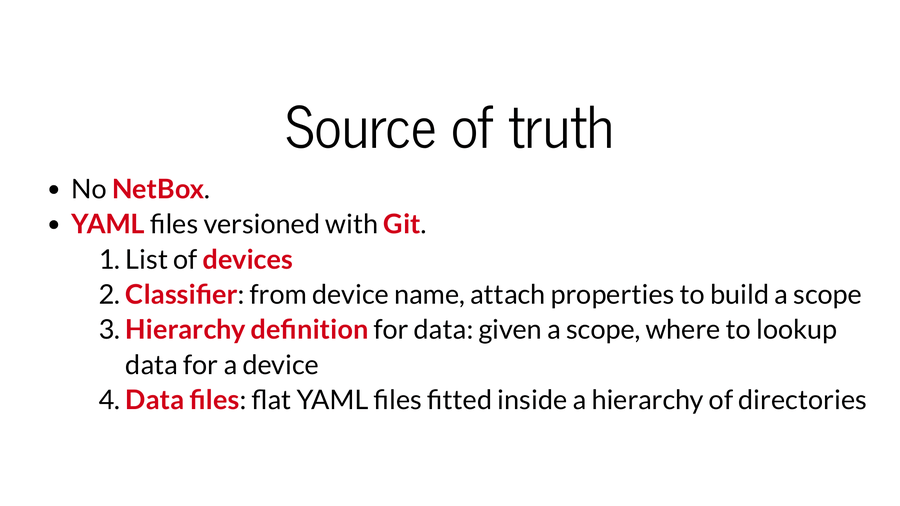
We have a source of truth. We chose that NetBox was not our source of truth. We use NetBox, but it is secondary. Our source of truth is flat files in YAML, versioned in Git. They include the equipment list, a classifier which, from a device name, gives the intrinsic properties of the device, a definition of a hierarchy to search for all other data, and all data files written in YAML and included in this hierarchy.
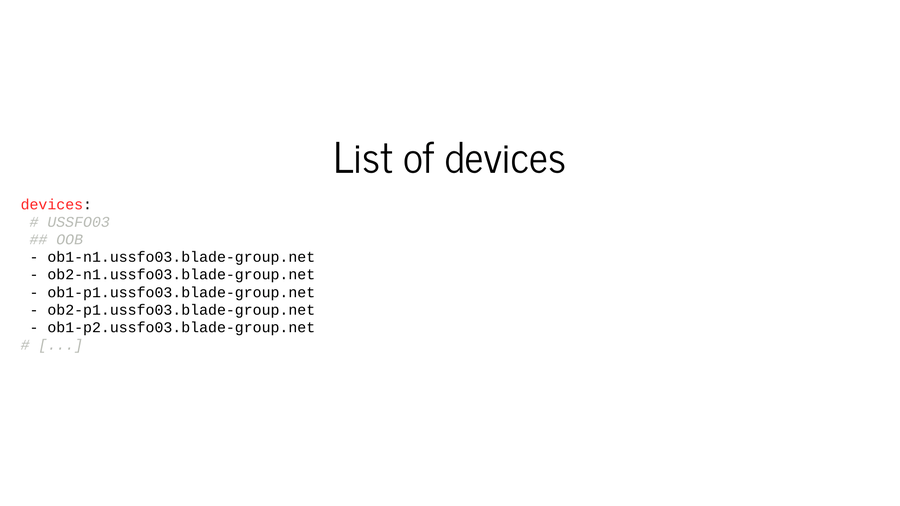
The equipment list is just a list containing the names of all the equipment. The
name of the equipment implies its function. This is not strictly necessary, but
it is simpler. For example, here it’s an equipment in San Francisco and ob
means it’s an OOB equipment.
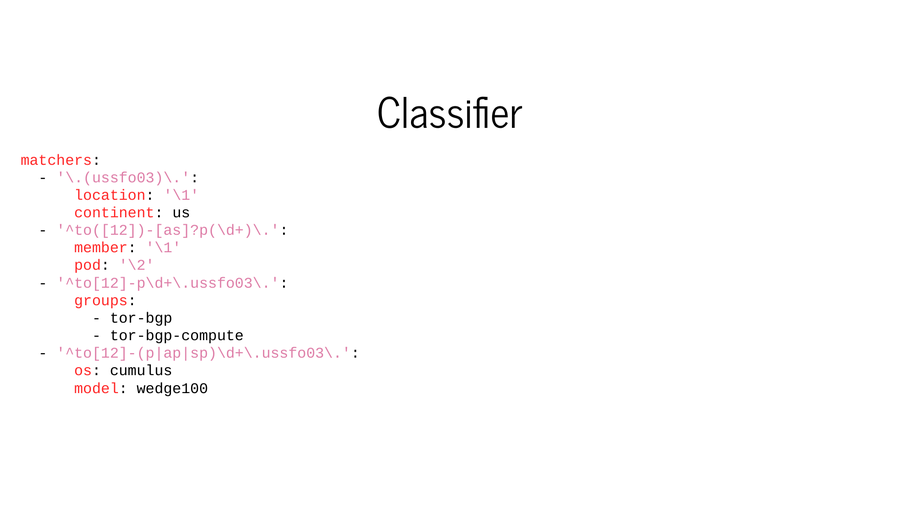
The classifier takes the name of the equipment and attaches properties to it.
These are only properties that can be inferred from the name. There are several
types of information: the physical location, the function of the equipment…
The to are the top-of-the-rack. When they’re in San Francisco, it’s a
BGP-based technology. And when they’re called -p, it’s a compute pod. They end
up in two groups that give this information. It also deduces the OS. These are
Facebook Wedge 100s running Cumulus. The classifier uses regexes to infer this
information from the name.
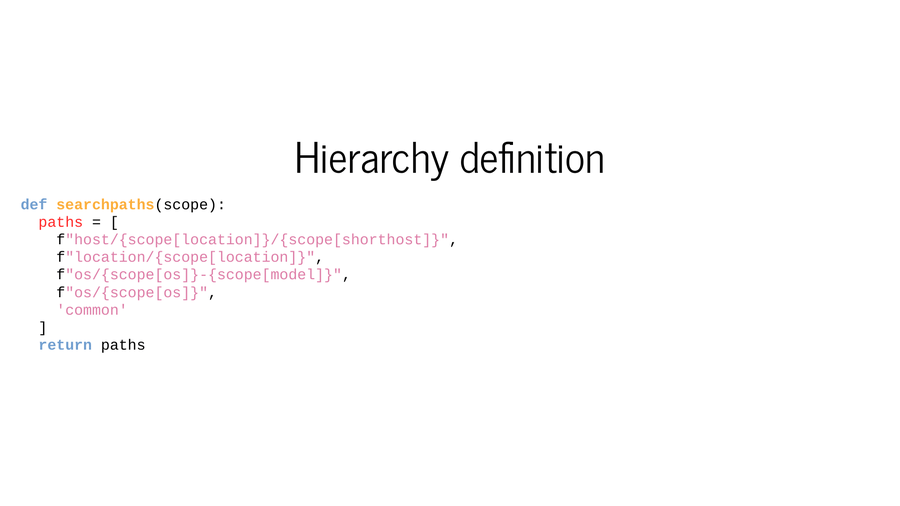
We have a definition of the hierarchy which, from the information deduced by the classifier, will indicate in which directories to look for the data files.
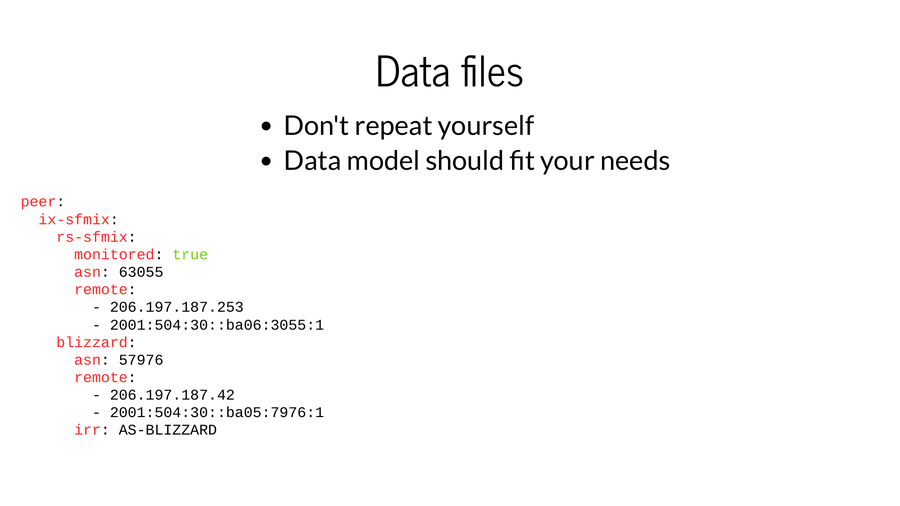
Finally, we have all the data files. The model is freeform. An important rule is not to have any repetition. If you put the same IP in two different files, there is a problem. Someone might change the IP at one location and forget at the other. We limit the models to our needs. We don’t try to invent needs that we don’t have yet. On this example, we define a peering on an IX. We give the name of the peering, the AS, the IPs. In this case with Blizzard, we give their macro to generate the filters to accept only their prefixes.
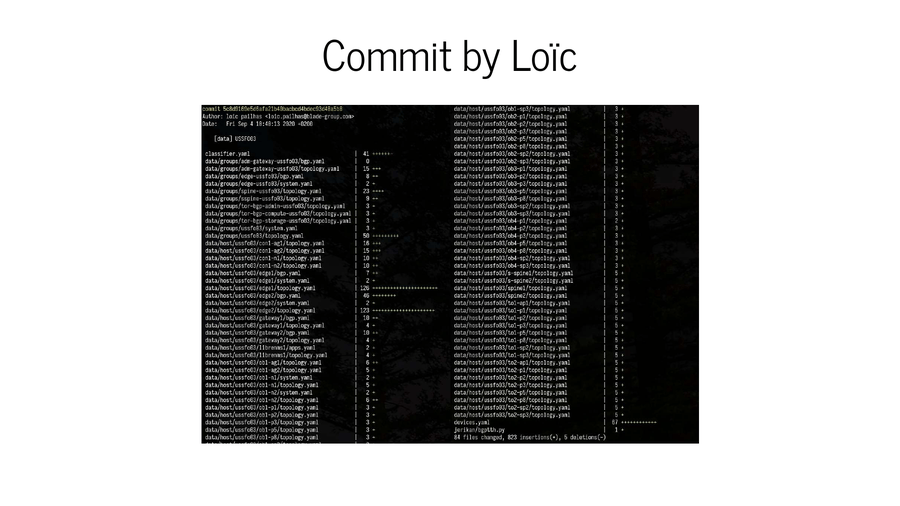
It’s a little hard to see but for the San Francisco datacenter, it was implemented in one commit. It was prepared over several weeks. The data needed to deploy the datacenter is spread across all these files. Some are specific to each equipment, often to give their IP and MAC addresses. Some are datacenter or rack specific. Once this commit has been accepted, the next step is to deploy with the commands I indicated at the beginning.
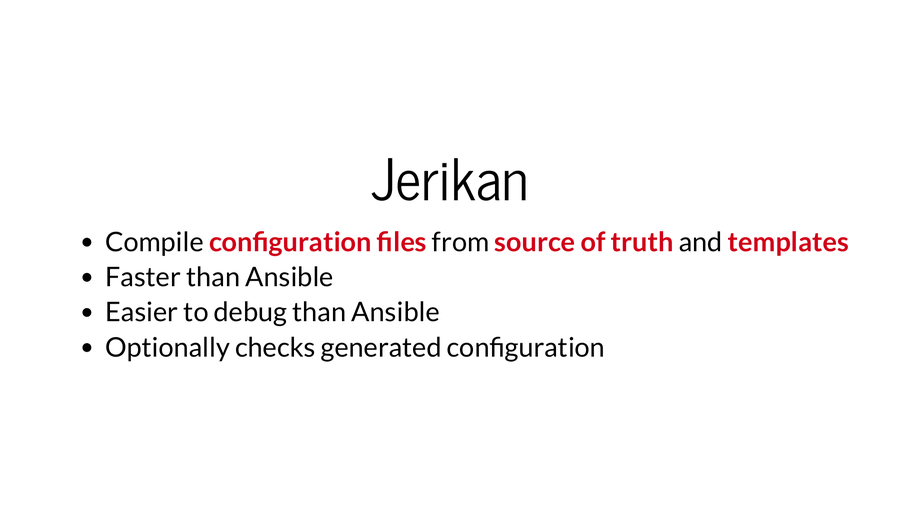
We have developed a software called Jerikan. Its function is to compile configuration files from the source of truth and templates. We didn’t use Ansible for this because Ansible is quite slow when it compiles templates. It’s a pain in the ass when you have to debug them. Jerikan answers these problems. It is extremely fast. We have about 600 devices. It generates the entire configuration, including edge routers with multi-megabyte BGP policies, in less than a minute.
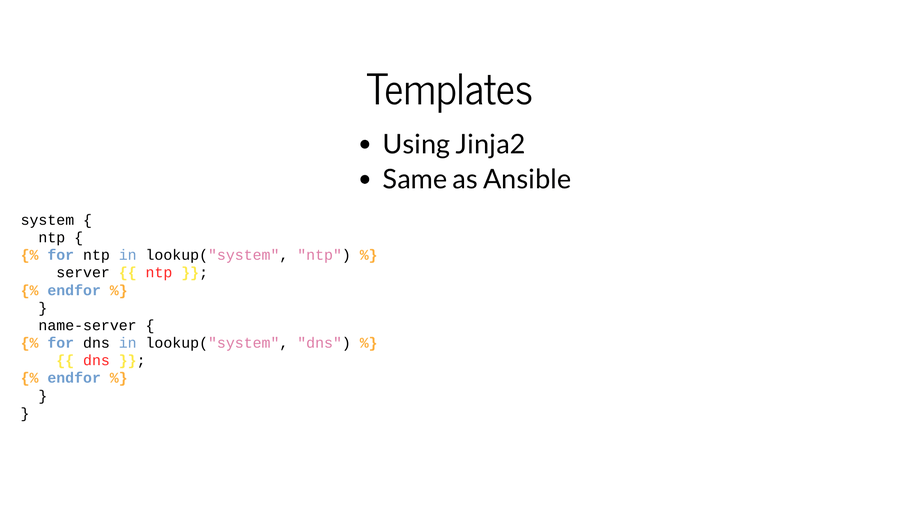
At the template level, we use Jinja2 because that’s what Ansible uses and that’s
what’s most common. We added some functions of our own, like the lookup()
function, which allows to look for data in the source of truth.
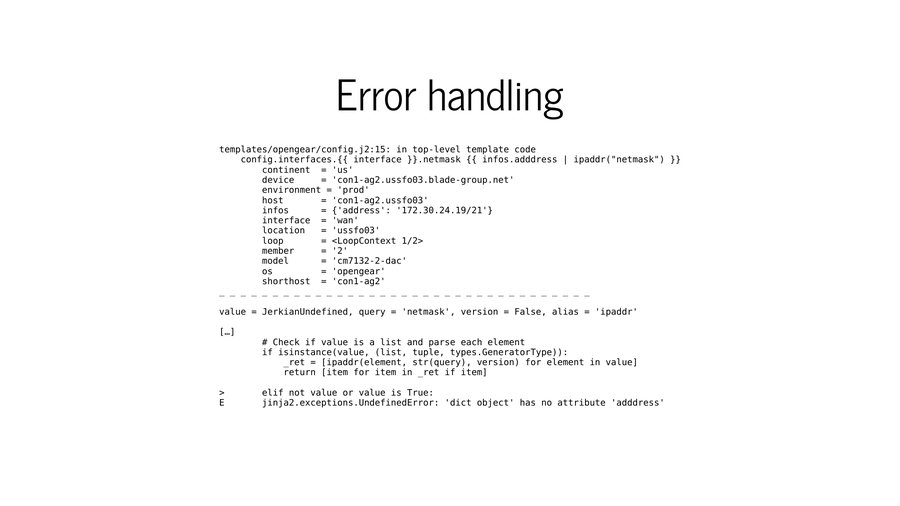
This is a small example when there is an error in a template to show the
difference with Ansible. There is an error. We get the line on which the error
is located: line 15. We also have all the variables that are currently in the
scope. The info dictionary contains address with two “d” and not three “d.”
This allows you to see where the error is without removing half the template.
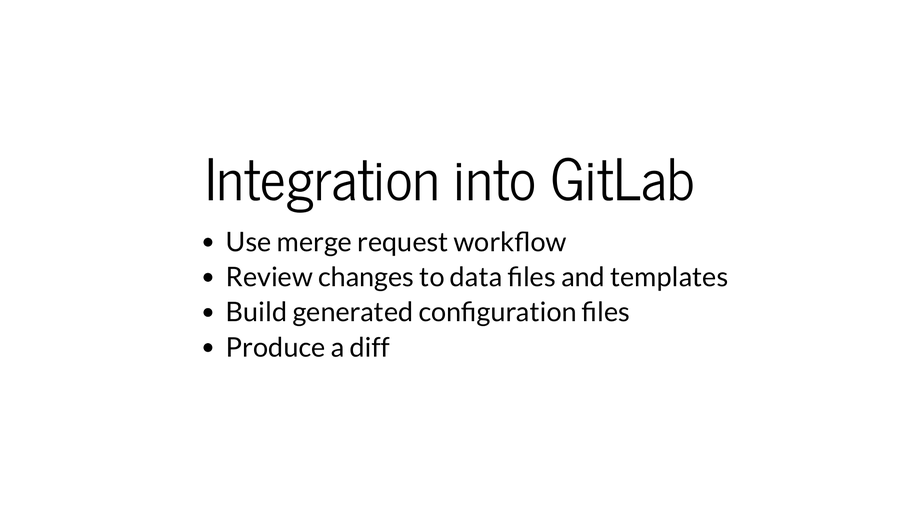
We have an integration in GitLab thanks to the use of Git. When Loïc wanted to prepare the deployment of San Francisco, we didn’t stop working. He’s doing a Git branch. He works on it as long as it takes. When he’s ready to deploy, he submits a merge request to GitLab. With the team we review it. People give feedback. We need at least one other person to approve before we can merge.
Also, GitLab will build all the configurations and show the difference from the configuration that is running on the hardware. When you make small changes, you don’t really know what the impact will be. Here, we can say that this change will do that. It’s pretty convenient to see the result.
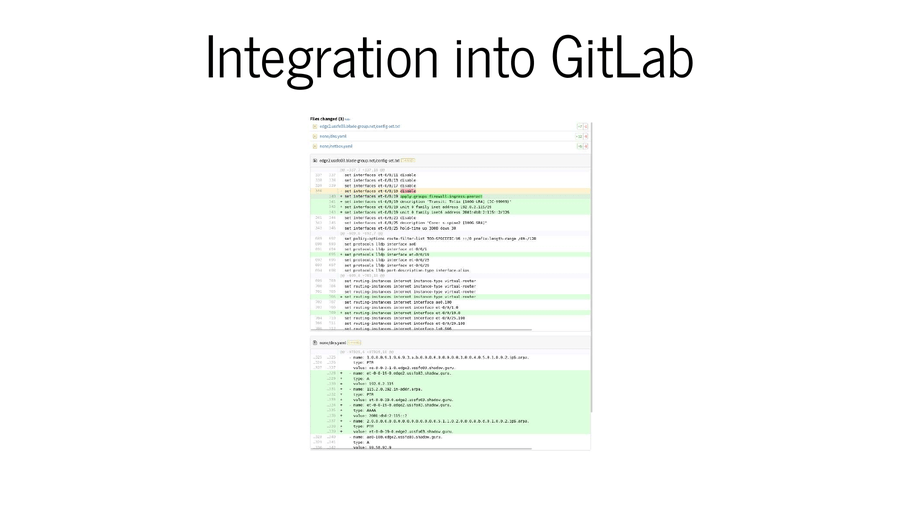
This is an example of a diff you get on a different kind of commit. We can see that there are added devices. There is a port that has been activated and the second part is about DNS.
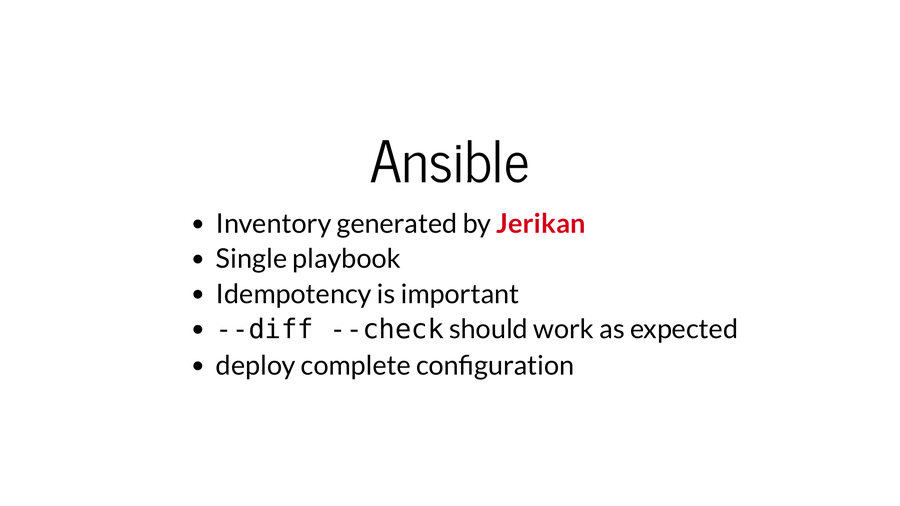
Then, we keep Ansible for the whole deployment part. We have very heterogeneous equipment like Dell OS 9 and HP Comware. You wouldn’t want to have them on your network but you still have to manage them. We use a single Ansible playbook. We avoid to let it run unattended on all the datacenters.
We make sure that the actions are idempotent: if we run the playbook three
times, it tells us that there are no more modifications. We make the
--diff --check work, namely that --check does not make any changes and
--diff shows the expected changes. So we can do it every week and see if
something has been changed without us knowing it and put the equipment in
question back into compliance. And on the network devices, we deploy full
configurations to make sure we’re running exactly what we expect.
If you want more information, there is a blog post with a video demo that goes into more detail.
We put everything in a GitHub repository, which contains Jerikan, our Ansible playbooks and all the data for the San Francisco and South Korea datacenters (they don’t exist anymore). This is the complete data. We didn’t change the IPs. We didn’t remove half of them. If you have enough money to buy 40 racks, you should be able to redeploy the same thing by typing the commands.
There are also the generated configurations. If you’re not interested in the automation part because you already have something, take a look at the generated configurations, including edge router configuration, BGP filters. This will show you what it looks like. This is quite interesting because in our industry, we have a lot of very simple examples and never a complete example. There, if you want a BGP fabric, two edge routers, you have the complete configuration.
Questions#
My question was about the fact that you say you deploy everything through Ansible. Did you encounter any problems? Are you using any specific modules? Compared to some vendors, there are not necessarily Ansible modules available. In that case, how do you proceed?
It depends on the vendor. We weren’t using Ansible Galaxy except for the vendor modules. For Juniper and Cisco, we used either the community modules or the vendor modules. With Juniper, we used NAPALM. For Cisco, we used the community module. For Cumulus, we considered it as a Linux and we didn’t use a specific module.
For your sensitive data, you encrypt it in Git by what means?
The whole Jerikan part doesn’t handle any secret. We use SSH keys for the users. For root passwords, they are hashed and we consider that robust enough. For all the secrets that must be in clear text, it is Ansible that handles them and they are stored in a Vault. The deployment is done from our laptops. We provide Ansible with a Vault token. In the GitLab and templates part, there are no secrets.
In Jerikan, for data that is in the form of nested dictionaries, did you choose a recursive merge or are you doing like Ansible with a single level?
The merge is only done at the first level. We have a schema which indicates for some data structures how they can be merged. But when we merge them, we only do it at the first level.
Why didn’t you use NetBox or a database and use YAML flat files?
We don’t use a database. We could have mixed a bit in NetBox and a bit in flat files. The point of doing everything in flat files is a single source of truth. A database is hard to fork. If you have a NetBox and you have to change something, then in the flat files, there is a desynchronization.
Deploying a datacenter can be a month’s work. Changing the schema can impact the work of others. The advantage of using Git is that you can do everything in one branch without impacting the others. It’s easy to rollback. If you make a mistake in NetBox, it’s more complicated to rollback. You can use a base for tests and a base for production, but you can have two people working on two different projects. Here, you can make as many branches as you want. We chose to put everything in flat files to allow us to embrace Git.