Reduce your France Télécom bill
Vincent Bernat
Note
This article was published in “W,” a web directory accompanied by several articles that I maintained between 1996 and 1998. For the purpose of historical preservation of this dial-up Internet era in France, it is reproduced here, translated into English.
The scenario is classic: you buy a modem, get an Internet subscription, surf for a month or more without a care, and then comes the France Télécom bill with a total amount spanning at least 4 digits. The charm is then broken and the conclusion is obvious: surfing is expensive. Yet there must be a way to reduce this bill while continuing to surf normally. There are indeed many ways to achieve this goal. Here are most of them.
Choosing your provider#
This seems obvious, but it deserves clarification for beginners in modem telecommunications: you must choose your provider above all based on where it is located. Today, most providers offer access points scattered throughout France. This access point is what you will call to connect to the Internet, and the price of the call will depend on the distance separating you from this point. So choose a provider that offers an access point in your local or extended local area.
What is this area? A consultation of the directory will show you. If you call your provider outside this area, chances are that the gigantic bill you received comes from there.
Some providers offer IP Kiosk. This is a service that allows you to call anywhere in France for the price of a local call. The number is the same for everyone. However, be careful, only take this solution as a last resort, indeed, the IP Kiosk has several drawbacks: it is slow (except in version 2, available only at certain providers including Wanadoo), often saturated (this will cost you several telephone units) and does not allow you to benefit from certain advantages (local package, primaliste, temporalis).
Choosing your connection hours#
Second technique to save several hundred French francs on the bill: choose your connection hours. If you were connecting at any time, you can undoubtedly significantly reduce your bill by following these tips. By calling during certain time slots, you can benefit from significant reductions.
At red rate (or normal), you pay one telephone unit (1 UT = FF 0.742 including VAT or FF 0.65 excluding VAT) every 3 minutes. At blue night rate, you pay one telephone unit every 9 minutes, which is a 200% reduction! Here is the table summarizing the different time slots:
| 6h→ | 8h→ | 12h30→ | 13h30→ | 18h→ | 21h30→ | 22h30→6h | |
|---|---|---|---|---|---|---|---|
| Monday to Friday | $$ | $$$$ | $$$ | $$$$ | $$$ | $$ | $ |
| Saturday | $$ | $$$$ | $$$ | $$ | $$ | $$ | $ |
| Sunday and public holidays | $$ | $$ | $$ | $$ | $$ | $$ | $ |
- $$$$ (Red): 1 UT every 3 minutes
- $$$ (White): 1 UT every 4 and a half minutes
- $$ (Blue): 1 UT every 6 minutes
- $ (Blue night): 1 UT every 9 minutes
In short, wait a little bit before connecting, it can save you a few francs. Do long transfers earlier in the morning or later in the evening, as the case may be.
Timing#
Now, you need to monitor each telephone unit. Any unit you start, you pay for. So you might as well consume it entirely.
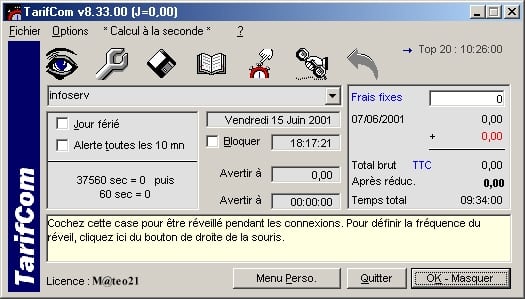
Two solutions are available to you: a watch, a pencil and a little patience, or software that replaces all that. The goal is to time precisely how long you have been connected since the remote modem picked up. This way, you can fully enjoy the unit and avoid hanging up when a new unit has just started.
Dedicated software like PTime or TarifCom is much more practical. They do all this automatically: calculate what you spent, track how long you stayed online, and warn you a few seconds before the end of the unit. Set this warning to around 25 seconds. This avoids having to abruptly cut the call or seeing the next unit pass during a hard disk swap. You will be able to fully enjoy the unit and also plan your connection sessions. You can estimate if you can afford to connect today. This helps avoid surprises when the bill arrives.
Local package, Primaliste, Temporalis#
Can we still save money? Yes! Get the local package right now without hesitation, as long as you spend more than 6 hours on the phone after 6 PM every month. For FF 30 per month, it offers you 6 free hours after 6 PM. In other words, for 6 hours, you get the blue night rate after 6 PM. Be careful however: the package actually covers 12 hours every two months. You can spend all your package during the first month. Also note that billing happens almost to the second. The minimum unit is the minute, then the second. If you connect for 54 seconds, one minute gets deducted from the package. If you connect for 1 minute and 16 seconds, that exact time gets deducted.
Now, you need to choose between Primaliste and Temporalis. Primaliste offers 15% discount on 6 chosen numbers and on calls of more than one minute. Temporalis offers a duration-based discount. You can get up to 30% discount on a phone call lasting more than 30 minutes. These two offers are not cumulative. You need to choose the one that suits you best: Primaliste for fairly short calls, Temporalis if you stay online for a long time. Your FT agency should be able to tell you which service is most profitable by examining your last bill.
These promotions are not applicable to IP Kiosk—except the local package!
A matter of organization#
We have seen the best ways to save on an FT bill. There are others whose results are more difficult to assess. You can write down on a piece of paper everything you need to do once connected. Then only connect when the paper is full enough, during a favorable time slot.
You can also try to automate as many things as possible. Launch several services automatically (email retrieval, news, etc.). Use tools to capture Web pages to view them offline and save online time. Read and write news offline. Do the same for mail. Also avoid IRC, as it costs a lot! 🙂 Launch multiple browsers to take advantage of all the bandwidth. Save what interests you to read it comfortably once disconnected. In short, automate!
And in the future?#
France Télécom wants to develop telecommunications in France and make us love the year 2000. They decided to simplify the grid of time slots. Good news? No. The white rate, and especially the blue night rate, will be eliminated! During the week, the blue rate will take effect around 6 PM. In short, at night, the hour will go from FF 5 to FF 7 (approximately). France Télécom has promised to study an offer for Internet users. Will we pay double what others pay?
At the start of the school year, we will also see the switch to per-second billing. Good news? Maybe. We have to see the conditions and especially the rates offered. One last thing: 1998 will be the year of deregulation of telecommunications in France. Competition will be able to propose offers that can only be cheaper. However, companies will mainly benefit. We still have a long way to go to have free local calls (or at one unit, regardless of duration) as is done in the United States or Canada.