Bot-free self-hosted analytics with GoatCounter on NixOS
Vincent Bernat
21-minute read
Also available in
Filed under
Attachment:
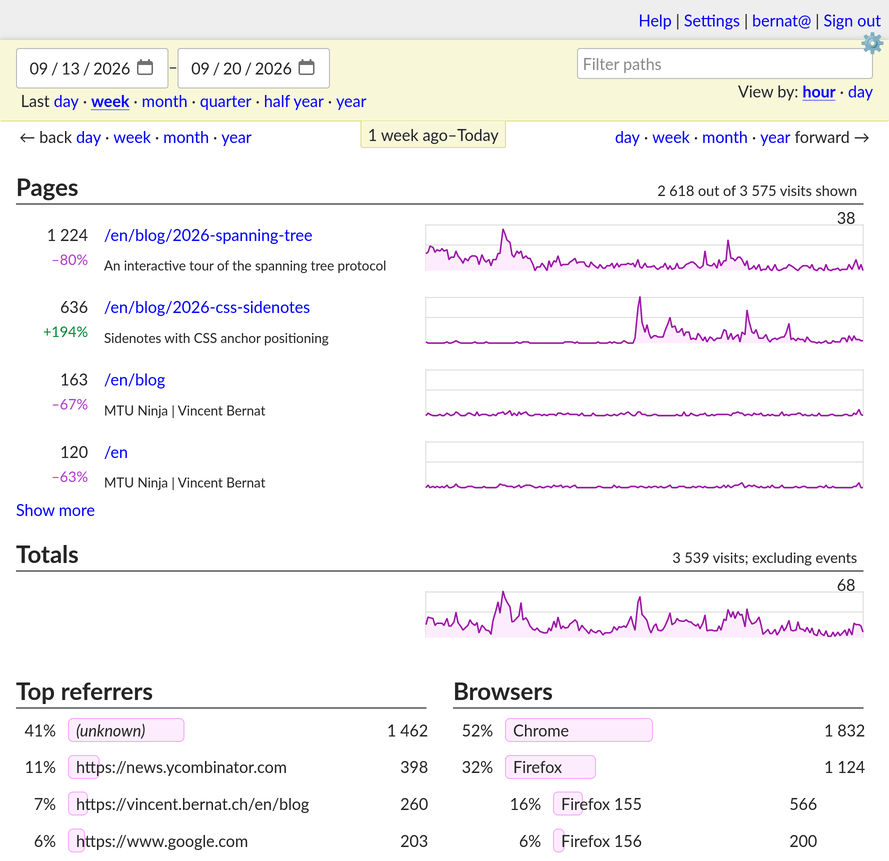
In 2016, I removed Google Analytics from this blog to avoid being complicit in feeding the biggest machine for harvesting personal data. Instead, I relied on GoAccess to analyze my server logs.1 For the past couple of years, the statistics have made no sense, despite my attempts to filter bots: AI scrapers inflate the number of visitors to around 2,000 per day. Eventually, I settled on GoatCounter, an open-source, privacy-friendly web analytics platform. I replaced the JavaScript client to filter bots more aggressively and added a CSS fallback. To improve reliability, I implemented a local proxy running on each of the five web servers serving this blog. The rest of this post details how these pieces fit together and how I deploy them on NixOS. ❄️
Why GoatCounter?#
GoatCounter does not collect personal data: instead of storing the reader’s IP address or relying on cookies, it creates a session identifier valid for 8 hours from the user agent and the IP address. Its feature set is modest but sufficient for a blog. If you want to look at the interface, GoatCounter’s author runs a public instance for his site. A hosted version lets you try it before running your own instance. With a single binary and an SQLite database, GoatCounter is one of the lightest self-hosted solutions. Privacy-friendly alternatives, in increasing order of complexity, include Umami, Plausible, and Rybbit.
Custom JavaScript client#
GoatCounter includes a small JavaScript client—2,189 bytes minified and gzipped. It ships some features I don’t use: a visitor counter, tracking clicks, configurable settings, etc. I replace it with this function to register a hit:
const count = ({ event, title } = {}) => {
  const params = new URLSearchParams({
    p: event || location.pathname,
    t: title || document.title,
    r: document.referrer,
    q: location.search,
    s: document.documentElement.clientWidth,
    e: !!event,
    rnd: Math.random().toString(36).slice(2, 7),
  });
  fetch(`/count?${params}`, { keepalive: true }).catch(() => {});
};
To filter bots,2 I go the extra mile by requiring a user interaction—an idea I stole from Bear Blog.
let sendHit = () => (sendHit = () => {}, count());
["touchmove", "mousemove", "keydown", "pointerdown"].forEach((eventName) =>
  document.addEventListener(eventName, sendHit, {
    once: true,
    passive: true,
  }),
);
If a reader has disabled JavaScript in their browser, I record the hit using a
CSS image. The :hover pseudo-class loads it only after an interaction, another
trick stolen from Bear Blog. About 2% of my visitors fit into this
bucket.3
<!DOCTYPE html>
<html lang="en" class="nojs">
  <head>
    <script>
      // The JavaScript code for this blog requires ES6
      if ("noModule" in HTMLScriptElement.prototype)
        document.documentElement.classList.remove("nojs");
    </script>
  </head>
  <body>
  <!-- ... -->
    <style>
      .nojs body:hover {
        border-width: 0;
        border-image: url('/count?p=/en/blog/2026-kpi-goodhart&t=Building...&r=NoJS&e=false');
      }
    </style>
  </body>
</html>
Where GoAccess reported around 2,000 visitors a day, GoatCounter counts fewer than 200 humans.4 I assume AI scrapers use a low-effort approach: if the content is available without barriers, as on this blog, they don’t spawn a complex mechanized browser that could trigger a page view. Even crawlers running JavaScript, like Googlebot with its headless Chromium, do not interact with the page and never trigger the events I listen to. The interaction-based “proof of humanity” I use is likely to keep working.
Local proxy#
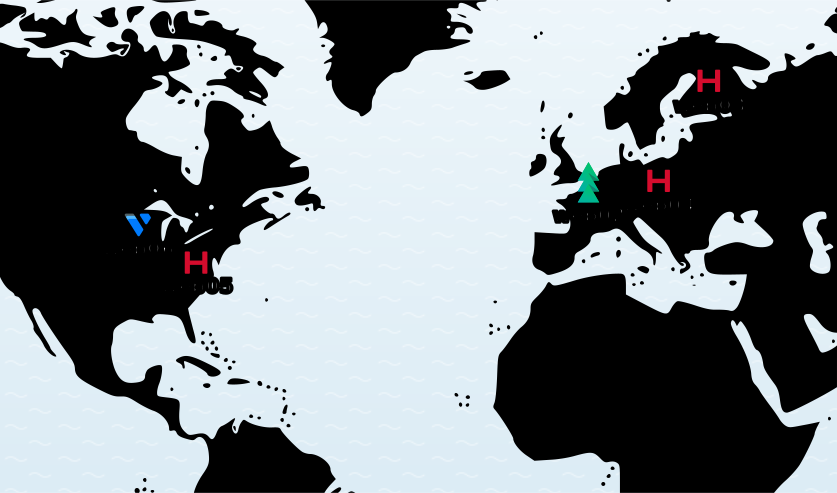
Five servers across the world in Europe and in North
America serve the content of this website, but GoatCounter runs on only
one of them. To avoid losing track of visitors when GoatCounter is down, I run a
local proxy listening on the same /count endpoint. On each server, it stores
the hits in memory with a buffer large enough to survive several days of
downtime. It sends them in batches to the upstream backend using the
/api/v0/count authenticated endpoint.
I proposed the code for the proxy in pull request #909. GoatCounter’s maintainer declined to maintain so much code for such a niche use case. As a fellow open-source developer, I often hold the same position for my own projects: a one-time contributor effort may translate into a long-term maintainer commitment.
I expose the endpoint for the proxy on the domain of this website to evade ad blockers. This sounds like I don’t respect the reader’s choice, but as GoatCounter is privacy-friendly, I find it acceptable.
location = /count {
  access_log off;
  proxy_pass http://127.0.0.3:8087/count;
  proxy_pass_request_headers off;
  proxy_set_header Accept-Language $http_accept_language;
  proxy_set_header User-Agent $http_user_agent;
  proxy_set_header X-Real-Ip $remote_addr;
}
Deploying on NixOS#
My web servers run NixOS, a declarative Linux distribution with built-in configuration management. I manage this small fleet with Colmena, a stateless deployment tool for NixOS. My configuration is available on GitHub.
Deploying applications in containers#
For better isolation, each application runs inside an ephemeral lightweight
container, powered by systemd-nspawn. Each container runs a stripped-down
NixOS instance. A module wraps NixOS’s containers options to
avoid repeating the same options for each application.5 The containers
share their network namespace with the host: the additional isolation is not
worth the increased complexity. For a smaller footprint, I also disable a few
non-essential services.
{ config, lib, ... }:
let
  cfg = config.luffy.containers;
in
{
  # User-configurable settings for our custom module
  options.luffy.containers = lib.mkOption {
    default = { };
    description = "Ephemeral containers sharing the host network.";
    type = lib.types.attrsOf (lib.types.submodule {
      options = {
        config = lib.mkOption {
          type = lib.types.deferredModule;
          default = { };
          description = "NixOS configuration of the container.";
        };
      };
    });
  };

  # Translate our options to NixOS containers
  config = {
    containers = lib.mapAttrs
      (name: container: {
        ephemeral = true;
        autoStart = true;
        privateNetwork = false;
        extraFlags = [ "--resolv-conf=replace-host" ];
        config = {
          imports = [ container.config ];
          networking.firewall.enable = false;
          system.stateVersion = config.system.stateVersion;
          systemd.services = {
            console-getty.enable = false;
            systemd-logind.enable = false;
            systemd-oomd.enable = false;
          };
        };
      })
      cfg;
  };
}
To configure a GoatCounter instance running in a container and listening on
127.0.0.4:8088, we import the module6 and declare the container in the
config.luffy.containers attribute set:
{ pkgs, config, ... }: {
  imports = [ ./modules/container.nix ];
  config.luffy.containers.goatcounter = {
    config = {
      services.goatcounter = {
        enable = true;
        address = "127.0.0.4";
        port = 8088;
        proxy = true;
      };
    };
  };
}
As the containers are ephemeral, we need to keep persistent data in directories
on the host. We add a mounts option and ask NixOS’s containers to expose the
configured directories through the bindMounts option.
{ config, lib, ... }:
let
  cfg = config.luffy.containers;
in
{
  options.luffy.containers = lib.mkOption {
    type = lib.types.attrsOf (lib.types.submodule {
      options = {
        mounts = lib.mkOption {
          type = lib.types.listOf lib.types.str;
          default = [ ];
          description = "Host directories mounted read-write at the same place.";
        };
      };
    });
  };

  config = {
    containers = lib.mapAttrs
      (name: container: {
        bindMounts =
          lib.genAttrs container.mounts (path: { hostPath = path; isReadOnly = false; });
      })
      cfg;
  };
}
For example, to persist GoatCounter’s database in the /var/db/goatcounter
directory on the host, we add the directory to the mounts option and alter the
service definition to tell GoatCounter where the database is.
{ config, ... }:
let
  databaseDirectory = "/var/db/goatcounter";
in {
  config.luffy.containers.goatcounter = {
    mounts = [ databaseDirectory ];
    config = {
      services.goatcounter = {
        extraArgs = [ "-db=sqlite+${databaseDirectory}/db.sqlite" ];
      };
    };
  };
}
A container may also need some secrets. Colmena can upload secrets without
storing them in the Nix store. We add a keys option to our containers. It
takes an attribute set mapping secret names to the commands to populate them.
Then, the module declares the required secrets to Colmena in the
deployment.keys option, makes the container depend on the presence of the
secrets, and exposes them to the container.
{ config, lib, ... }:
let
  cfg = config.luffy.containers;
in
{
  options.luffy.containers = lib.mkOption {
    type = lib.types.attrsOf (lib.types.submodule {
      options = {
        keys = lib.mkOption {
          type = lib.types.attrsOf (lib.types.listOf lib.types.str);
          default = { };
          description = "Secrets, as a command to run locally. They are mounted in /etc.";
        };
      };
    });
  };

  config = {
    # Colmena uploads each secret in `/var/keys` and make them available
    # to the group "keys".
    deployment.keys = lib.concatMapAttrs
      (_: container: lib.mapAttrs
        (_: keyCommand: {
          inherit keyCommand;
          group = "keys";
          permissions = "0640";
          destDir = "/var/keys";
        })
        container.keys)
      cfg;

    # The container can only start if the required secrets are available.
    systemd.services = lib.mapAttrs'
      (name: container:
        let
          units = map (key: "${key}-key.service") (lib.attrNames container.keys);
        in
        lib.nameValuePair "container@${name}" {
          requires = units;
          after = units;
        })
      cfg;

    # Mount each secret inside the container.
    containers = lib.mapAttrs
      (name: container: {
        bindMounts = lib.mapAttrs'
          (key: _: lib.nameValuePair "/etc/${key}" {
            hostPath = "/var/keys/${key}";
            isReadOnly = true;
          })
          container.keys;
      })
      cfg;
  };
}
For example, GoatCounter needs credentials to download the GeoIP database. I
provide a local command to fetch the secret from my password manager and expose
it inside the container through the /etc/goatcounter.env environment file.
{ pkgs, config, ... }:
let
  keyCommand = variable: [
    "${pkgs.runtimeShell}"
    "-c"
    "pass show personal/nixops/secrets | grep '^${variable}='"
  ];
in {
  config.luffy.containers.goatcounter = {
    keys."goatcounter.env" = keyCommand "GOATCOUNTER_GEODB";
    config = {
      systemd.services.goatcounter.serviceConfig = {
        EnvironmentFile = "/etc/goatcounter.env";
        SupplementaryGroups = [ "keys" ];
      };
    };
  };
}
GoatCounter server#
Nixpkgs already packages GoatCounter. By overriding the src and vendorHash
attributes, I reuse its definition for my custom version with the proxy:
{ goatcounter, fetchFromGitHub }:
goatcounter.overrideAttrs (_: {
  src = fetchFromGitHub {
    owner = "vincentbernat";
    repo = "goatcounter";
    rev = "feature/proxy";
    hash = "sha256-dJRlQlFu3tjcEgabT1LEbyFrasJlhmYu4L/T7EkoNcY=";
  };
  vendorHash = "sha256-c9Q5OrbZR+q6pD3SgPPWe8JUzcZco1AVUKGaV61k5DE=";
})
I wrote a NixOS module to encapsulate GoatCounter: the
container definition, the service definition, and the secrets. The module
accepts the following options: package, serve.enable, serve.listenAddress,
serve.port, and serve.databaseFile. I already detailed the container
configuration in the previous section. In the end, I chose not to reuse the
GoatCounter module from NixOS: it’s small, so it’s better to insulate my module
from unexpected future changes.
{ config, pkgs, lib, ... }:
let
  cfg = config.luffy.goatcounter;
  databaseDirectory = builtins.dirOf cfg.serve.databaseFile;
  chown = "${pkgs.coreutils}/bin/chown -R";
in {
  config.luffy.containers.goatcounter = {
    config.systemd.services.goatcounter = {
      description = "GoatCounter Web Analytics";
      wantedBy = [ "multi-user.target" ];
      serviceConfig = {
        EnvironmentFile = "/etc/goatcounter.env";
        SupplementaryGroups = [ "keys" ];
        DynamicUser = true;
        Restart = "always";
        ExecStart = lib.escapeShellArgs [
          (lib.getExe cfg.package)
          "serve"
          "-listen=${cfg.serve.listenAddress}:${toString cfg.serve.port}"
          "-tls=none"
          "-db=sqlite+${cfg.serve.databaseFile}"
          "-automigrate"
        ];
        # Transfer database ownership to dynamically assigned user "goatcounter".
        ExecStartPre = "+${chown} goatcounter:goatcounter ${databaseDirectory}";
        ReadWritePaths = databaseDirectory;
      };
    };
  };
}
The following snippet configures GoatCounter to listen on 127.0.0.4:8088:
{
  luffy.goatcounter = {
    serve = {
      enable = true;
      listenAddress = "127.0.0.4";
      port = 8088;
    };
  };
}
The last step is to configure nginx to expose GoatCounter on the Internet. I
disable the /count endpoint as the local proxy handles it.
{ config, ... }:
let
  cfg = config.luffy.goatcounter.serve;
in
{
  services.nginx.virtualHosts."goatcounter.luffy.cx" = {
    forceSSL = true;
    locations = {
      "/" = {
        proxyPass = "http://${cfg.listenAddress}:${toString cfg.port}";
      };
      "= /count".extraConfig = ''
        return 404;
      '';
    };
  };
}
GoatCounter proxy#
The same NixOS module configures the local proxy, with the
following options: proxy.enable, proxy.listenAddress, proxy.port, and
proxy.site—the site receiving the batches of page views. The local proxy has
no persistent data, but it needs the API key to authenticate to the main
GoatCounter instance: its container uses the keys option but not the mounts
option.
{ config, pkgs, lib, ... }:
let
  cfg = config.luffy.goatcounter;
  keyCommand = _: [ "…" ];
in
{
  config.luffy.containers.goatcounter-proxy = {
    keys."goatcounter-proxy.env" = keyCommand "GOATCOUNTER_API_KEY";
    config.systemd.services.goatcounter = {
      description = "GoatCounter Proxy.";
      wantedBy = [ "multi-user.target" ];
      serviceConfig = {
        EnvironmentFile = "/etc/goatcounter-proxy.env";
        SupplementaryGroups = [ "keys" ];
        DynamicUser = true;
        Restart = "always";
        ExecStart = lib.escapeShellArgs [
          (lib.getExe cfg.package)
          "proxy"
          "-site=${cfg.proxy.site}"
          "-listen=${cfg.proxy.listenAddress}:${toString cfg.proxy.port}"
          "-ratelimit=10/1"  # 10 requests per second per IP
        ];
      };
    };
  };
}
For each server, I enable the local proxy with the following snippet. The
nginx configuration shown earlier exposes the /count endpoint under the same
domain as my blog.
{
  luffy.goatcounter = {
    proxy = {
      enable = true;
      site = "goatcounter.luffy.cx";
      listenAddress = "127.0.0.3";
      port = 8087;
    };
  };
}
Backup of the SQLite database with Litestream#
Litestream is a streaming replication tool for SQLite databases. It
compresses the changes committed to the write-ahead log (WAL) next to the
database and sends them to a remote destination. I encapsulate its configuration
in a NixOS module, which takes an attribute set databases
mapping a name to the path of the database to back up.
Litestream also runs in a container. I mount the databases to replicate, as well as the secrets to push the backups to a Hetzner storage box using SFTP:
{ config, pkgs, lib, ... }:
let
  cfg = config.luffy.litestream;
  databaseDirs = lib.unique (map builtins.dirOf (builtins.attrValues cfg.databases));
in
{
  config = lib.mkIf (cfg.databases != { }) {
    luffy.containers.litestream = {
      mounts = databaseDirs;
      keys."litestream.env" = [
        "${pkgs.runtimeShell}"
        "-c"
        "pass show personal/nixops/secrets | grep '^SQLITE_BACKUP_'"
      ];
    };
  };
}
Inside the container, I configure Litestream through NixOS’s
services.litestream options:
- full snapshots every day, kept for 15 days,
- three levels of compaction for transaction files: 5 minutes, 30 minutes, and 3 hours,
- auto-recovery,7
- replica stored in a directory matching the host name, and
- credentials read from
/etc/litestream.envand exposed through variable expansion.
{ config, pkgs, lib, ... }:
let
  cfg = config.luffy.litestream;
in
{
  config.luffy.containers.litestream = {
    config = {
      # The databases belong to dynamically allocated users, whose UID is
      # not known here, so Litestream runs as root.
      systemd.services.litestream.serviceConfig = {
        User = lib.mkForce "root";
        Group = lib.mkForce "root";
      };
      # Use NixOS service.
      services.litestream = {
        enable = true;
        environmentFile = "/etc/litestream.env";
        settings = {
          auto-recover = true;
          snapshot = {
            interval = "24h";
            retention = "360h";
          };
          levels = [
            { interval = "5m"; }
            { interval = "30m"; }
            { interval = "3h"; }
          ];
          dbs = lib.mapAttrsToList
            (name: path: {
              inherit path;
              replica = {
                type = "sftp";
                host = "\${SQLITE_BACKUP_HOST}";
                user = "\${SQLITE_BACKUP_USER}";
                password = "\${SQLITE_BACKUP_PASSWORD}";
                host-key = "\${SQLITE_BACKUP_HOSTKEY}";
                path = "${config.networking.hostName}/${name}";
              };
            })
            cfg.databases;
        };
      };
    };
  };
}
To back up GoatCounter’s database, I declare a goatcounter attribute in
luffy.litestream.databases, set to the database path:
{ config, ... }:
let
  cfg = config.luffy.goatcounter.serve;
in
{
  luffy.litestream.databases.goatcounter = cfg.databaseFile;
}
On the SFTP server, we can inspect Litestream’s work, with the compacted transactions and the full snapshots:
❯ ls web02/goatcounter/ltx
web02/goatcounter/ltx/0
web02/goatcounter/ltx/1
web02/goatcounter/ltx/2
web02/goatcounter/ltx/3
web02/goatcounter/ltx/9
❯ ls -lh web02/goatcounter/ltx/1
29.1K Sep  5 01:25 0000000000003f2a-0000000000003f2b.ltx
72.4K Sep  5 02:03 0000000000003f2c-0000000000003f2d.ltx
63.3K Sep  5 02:24 0000000000003f2e-0000000000003f2f.ltx
[…]
❯ ls -lh web02/goatcounter/ltx/9
 8.5M Sep  5 02:00 0000000000000001-0000000000003f2b.ltx
 8.5M Sep  6 02:03 0000000000000001-0000000000004008.ltx
 8.6M Sep  7 02:03 0000000000000001-00000000000043a8.ltx
[…]
We can restore the database from the backup with a few shell commands. First, we
stop the containers. Then, we move the damaged database away, invoke litestream
restore from the right environment, and restart the containers.8
# systemctl stop container@goatcounter container@litestream
# mv /var/db/goatcounter/db.sqlite{,.old}
# ( . /etc/nixos-containers/litestream.conf ;
>   set -a ; . /var/keys/litestream.env ; set +a ;
>   $SYSTEM_PATH/sw/bin/litestream \
>     restore -config $SYSTEM_PATH/etc/litestream.yml /var/db/goatcounter/db.sqlite)
# ls -lh /var/db/goatcounter/db.sqlite
-rw-r--r-- 1 root root 20M Sep 20 07:33 /var/db/goatcounter/db.sqlite
# systemctl start container@goatcounter container@litestream
Ten years after removing Google Analytics, JavaScript-based analytics is back on this blog, but without storing cookies or IP addresses, and without involving a third party. I still write for myself first, notably because it lets me dig into a topic and refer back to it years later. But knowing a bit more about my fellow human readers is a nice bonus, even the ones disabling JavaScript. 🐐